10 Expert Claim Tips for Historic Home Damage in Richmond, VA
Expert Claim Tips for Historic Home Damage in Richmond, VA
Owning a historic home in Richmond is a labor of love, but when disaster strikes—whether it is a fallen oak in the Fan District or a burst pipe in a Church Hill federal-style rowhouse—the insurance claim process becomes significantly more complex than a standard homeowner's claim. Navigating the intersection of modern insurance policies and strict local preservation mandates requires a specialized approach. Without the right strategy, property owners often find themselves caught between an insurance company that wants to pay for the cheapest materials and a city government that legally mandates expensive, historically accurate restoration.
How do you handle a historic home insurance claim in Richmond? To successfully file a claim for historic home damage in Richmond, VA, homeowners must document damage using moisture mapping and NWS data, obtain a Certificate of Appropriateness (COA) from the Commission of Architectural Review (CAR), and ensure their policy includes 'Ordinance or Law' coverage to account for modern preservation mandates and premium materials like slate and copper.
1. Why Richmond Historic Claims are Different: The Preservation Gap
Richmond's historic neighborhoods, such as the Museum District and Jackson Ward, are protected by specific zoning overlays that traditional insurance adjusters often overlook. When an adjuster from a national carrier arrives at your property, they are typically using software designed for modern stick-built suburban homes. This creates an immediate "preservation gap" where the estimated cost of repairs does not account for the labor-intensive techniques required to maintain the architectural integrity of a century-old structure.
The Intersection of Insurance and City Regulation
In Richmond, your home may fall under the jurisdiction of the Commission of Architectural Review (CAR). If your property is located within one of the City’s Old and Historic Districts, you are legally bound to repair it using specific materials. If your insurance company only offers to pay for 3-tab asphalt shingles when the city requires Buckingham Slate, you are facing a massive out-of-pocket deficit. Understanding that your claim is not just a private contract but a matter of local law is the first step toward a fair settlement.
National Register vs. Local Regulatory Districts
It is vital to distinguish between being on the National Register of Historic Places and being in a City Old and Historic District. The National Register is largely honorary and provides tax incentive opportunities but does not restrict what you can do with your property. However, Richmond’s local districts are regulatory. If your home is in the latter, the City of Richmond has the power to dictate the type of windows, siding, and roofing you use, which directly impacts the "replacement cost" your insurance company is obligated to pay.
2. Critical Documentation: Moving Beyond Standard Photos
A few cell phone pictures are rarely enough to settle a historic claim. Because historic materials like lime-plaster and heart pine flooring react differently to moisture than modern drywall and laminate, the documentation process must be scientific. If you have experienced water and flood damage, simple visual inspections will miss the moisture trapped behind thick masonry walls or underneath multi-layered subfloors.
Leveraging NWS Wakefield Data for Date-of-Loss
Insurance companies often try to deny claims by arguing that damage is "wear and tear" or occurred over a long period. For Richmond homeowners, we recommend sourcing official meteorological reports from the National Weather Service (NWS) Wakefield office. By providing specific wind speed data or hail diameters recorded at the Richmond International Airport on the night of the storm, you can provide irrefutable evidence that the loss occurred during a single, covered event rather than through gradual deterioration.
Advanced Moisture Mapping and Thermal Imaging
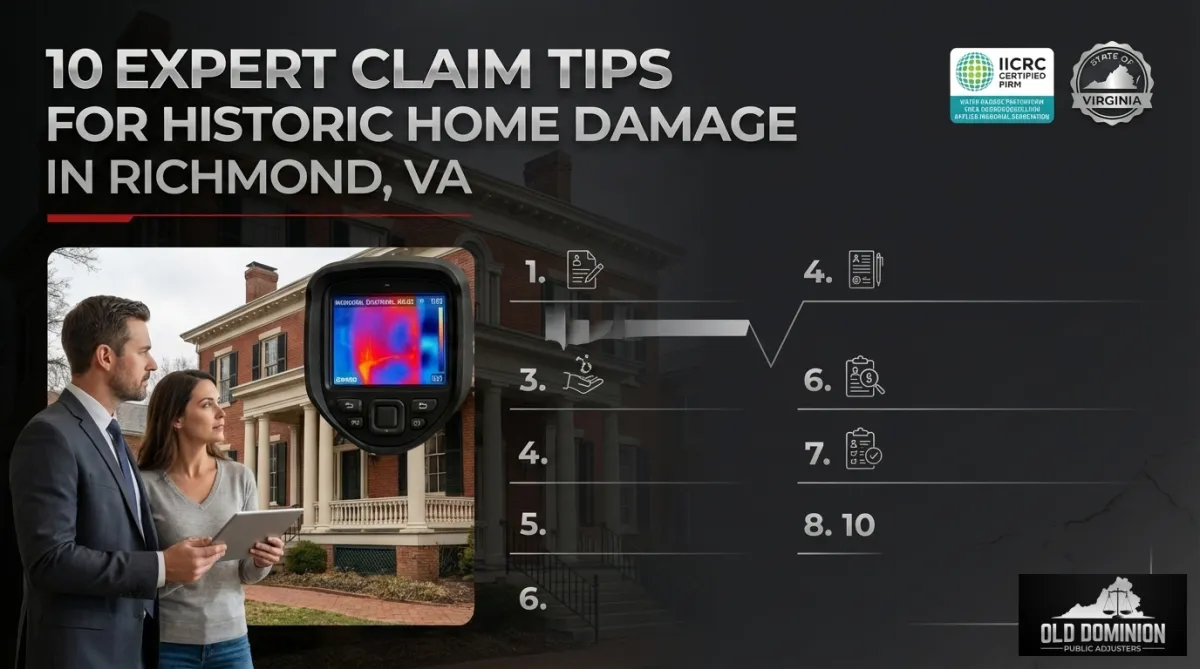
Historic Richmond homes often feature "wet-plaster" walls which can hold gallons of water without showing immediate staining. Professional public adjusters use infrared thermal imaging to identify temperature anomalies that indicate hidden moisture. Creating a comprehensive moisture map of your historic property ensures that the insurance company pays for the necessary industrial drying equipment or full plaster replacement rather than a cheap "patch and paint" job that will lead to mold down the road.
3. The Insurance Gap: 'Like Kind' vs. Richmond Historic District Mandates
Most insurance policies contain a "Like Kind and Quality" clause. This means the insurer is obligated to replace damaged items with materials of similar utility and value. However, in a historic context, "Like Kind" is often a point of contention. Is a modern fiberglass window of "Like Kind" to a 100-year-old restored wavy-glass window? The answer is almost always no, yet insurers will push for the modern, cheaper alternative to save costs.
Defining Quality for Slate, Copper, and Plaster
If your Fan District home has a slate roof, the carrier might suggest an "imitation slate" or an architectural shingle. You must firmly establish that Buckingham Slate—the traditional Virginia material—is a unique commodity with a 150-year lifespan. Substituting it with a 30-year product is not "Like Kind." The same applies to copper gutters; their longevity and aesthetic value cannot be replicated by aluminum. Documenting the specific gauges of copper and types of slate is essential for accurate valuation.
Using the CAR Handbook as Legal Evidence
One of the most effective tools in a Richmond historic claim is the Commission of Architectural Review (CAR) Handbook. This official document outlines the design guidelines for Richmond’s historic districts. If the handbook states that "original window patterns must be maintained" or that "slate is the required roofing material for the district," this can be used as legal leverage. It transforms the choice of material from a homeowner's preference into a legal requirement, forcing the insurer's hand under the 'Ordinance or Law' section of the policy.
4. Navigating the Richmond CAR: Obtaining your Certificate of Appropriateness (COA)
In Richmond’s Old and Historic Districts, you cannot simply start repairs after a storm damage event. You must first obtain a Certificate of Appropriateness (COA). This process involves submitting your repair plans to city staff or the full Commission to ensure they meet preservation standards. This added layer of bureaucracy is often frustrating, but it is a critical component of your insurance claim because the COA provides a formal "scope of work" that the insurance company must recognize.
Fast-Tracking via Emergency Administrative Approval
Waiting for a monthly CAR hearing while your roof is leaking is not feasible. Richmond offers an "Emergency Administrative Approval" process for stabilization repairs. This allows city staff to approve immediate actions—like tarping a roof or boarding up windows—without a full hearing. Ensure you document this emergency approval and present it to your adjuster. It proves that you acted to mitigate further damage (a policy requirement) while adhering to local law.
The Burden of Proof for Material Approval
If the insurance company refuses to pay for the required materials, you may need to go before the CAR to seek a denial for the cheaper materials the insurance company wants to use. If the CAR formally denies the use of vinyl windows or asphalt shingles on your property, you then have a government-issued document stating that the insurer's proposed settlement is illegal. This is a powerful piece of evidence in any claim dispute or appraisal process.
5. Policy Check: Does Your Richmond Home Have 'Ordinance or Law' Coverage?
Ordinance or Law coverage is perhaps the most important endorsement for a Richmond historic property owner. Standard policies typically only pay to repair a home to its original state. However, modern building codes and historic district mandates often require upgrades that didn't exist when the house was built. For example, if you have a fire, the city may require you to install a modern sprinkler system or update 1920s-era knob-and-tube wiring before they will issue a certificate of occupancy.
How Ordinance or Law Coverage Bridges the Cost Gap
Without this coverage, the insurance company will only pay for the cost of the old, outdated materials. You would be responsible for the massive price difference required to bring the home up to current Richmond city codes. For historic homes, we typically recommend a minimum of 10% to 25% of the dwelling limit for Ordinance or Law coverage. If you are unsure if you have this, a public adjuster can review your "Declarations Page" to confirm your limits.
Common Code Triggers in Historic Richmond
Beyond preservation rules, Richmond's building inspectors often trigger code upgrades during major insurance repairs. Common triggers include lead-based paint abatement, asbestos remediation in old pipe insulation, and structural seismic retrofitting in heavy masonry buildings. Each of these can add tens of thousands of dollars to a claim. If your fire and smoke damage claim doesn't account for these, your settlement will fall short.
6. Sourcing the Artisans: Vetting Richmond Contractors for Slate, Copper, and Plaster
Richmond has a rich community of tradespeople, but not every contractor is qualified to work on a historic home. Insurance companies often use "preferred vendors" who are high-volume, general-purpose restoration companies. These companies often lack the specialized knowledge required for lime-plaster repair or historic masonry repointing. Using the wrong contractor can lead to permanent damage, such as using modern Portland cement on soft historic bricks, which causes them to shatter during freeze-thaw cycles.
DPOR Licensing: Class A vs. Class B Requirements
In Virginia, the Department of Professional and Occupational Regulation (DPOR) regulates contractors. For significant historic claims, you should almost always insist on a Class A contractor. Class A contractors have no restrictions on the size of the contracts they can take, whereas Class B and C have strict monetary caps. Given that a slate roof replacement or a full historic kitchen restoration in the Fan can easily exceed $100,000, ensuring your contractor has the proper financial backing and licensing is a crucial safeguard.
Verifying Historic Experience
Ask potential contractors for a list of projects they have completed that required COA approval from the Richmond CAR. A contractor who is familiar with the Richmond city staff will be able to navigate the permitting process much faster. Furthermore, verify that they have the specific tools and materials, such as sourcing salvaged heart pine or matching existing mortar colors using traditional sand-and-lime ratios.
7. Financial Safety Nets: Leveraging Virginia Historic Rehabilitation Tax Credits
While an insurance settlement is your primary source of recovery, Richmond homeowners should also be aware of the Virginia Historic Rehabilitation Tax Credit (HRTC) program. If your repairs go beyond the scope of the insurance claim—or if you choose to do additional upgrades during the restoration process—these tax credits can significantly offset the cost. Virginia offers one of the most generous programs in the country, providing a 25% state tax credit for eligible rehabilitation expenses.
Coordinating Insurance Payouts with Tax Credits
It is important to note that you cannot usually claim a tax credit on the portion of the project paid for by insurance proceeds (as that would be "double dipping"). However, for any costs that exceed your insurance settlement—such as deductibles, upgrades, or items not covered by the policy—the HRTC can be a lifesaver. This is especially useful for developers in Richmond who are converting historic buildings and facing massive insurance premium taxes.
The Part 2 Application Process
To qualify for these credits, you must file an application with the Virginia Department of Historic Resources (DHR). This process should happen concurrently with your insurance claim. Having a clear set of "before" photos (which you should already have for your claim) is the first step in the Part 1 and Part 2 application process. Professional public adjusters can help ensure your documentation is robust enough to serve both the insurance carrier and the DHR auditors.
8. Richmond Clay and Foundation Claims: The Hidden Damage Factor
Richmond’s unique geology often plays a silent but destructive role in historic home claims. Much of the city sits on highly expansive clay soil. When a major water event occurs—such as a localized flood or a massive pipe burst that saturates the crawlspace—the soil composition can change rapidly. For historic brick-and-mortar foundations, this can lead to settling, cracking, and structural failure that might not be immediately apparent.
How Local Soil Impacts Post-Storm Stability
Historic foundations were not built with modern footings or drainage systems. When Richmond clay absorbs excessive water, it swells; when it dries, it shrinks. This movement can pull apart historic masonry joints. If you have experienced a major water loss, do not settle your claim until a structural engineer familiar with Richmond’s soil has inspected your foundation. If the insurer ignores the soil impact, you may find your house sinking years after the claim is closed.
Soil Testing and Structural Engineering
Insurance adjusters are trained to look at surface damage. They see a crack in the plaster and suggest a patch. A public adjuster, however, will look deeper. We often recommend hiring a geotechnical engineer to perform soil testing if there is evidence of foundation movement following a storm. Proving that the water event caused a change in the soil's bearing capacity is essential for securing the funds needed for foundation stabilization or helical pier installation.
9. Dispute Resolution: When to Contact the Virginia Bureau of Insurance
If you have followed all the steps—documented the damage, obtained CAR approval, and hired an expert—and the insurance company still refuses to pay a fair amount, you have options for dispute resolution in Virginia. The Virginia Bureau of Insurance (part of the State Corporation Commission) handles complaints against carriers. While they cannot always force a company to pay a specific dollar amount, they can investigate whether the carrier is violating the Virginia Unfair Claim Settlement Practices Act.
Escalating Claims for Underpayment
In many historic home claims, the dispute centers on the cost of labor and materials. If the insurer is using "national average" pricing that is 40% lower than what Richmond's historic artisans actually charge, you can invoke the "Appraisal Clause" in your policy. This is a form of alternative dispute resolution where two independent appraisers and an umpire determine the final value of the loss, often bypassing the need for a lawsuit.
The Role of a Public Adjuster in Richmond
A public adjuster acts as your advocate throughout this entire process. Unlike the insurance company's adjuster, a public adjuster works only for you. In Richmond, this means having someone who understands how to talk to the CAR, how to value a slate roof, and how to push back against lowball estimates using local market data. By handling the documentation, negotiation, and city compliance, a public adjuster ensures that your historic home is restored to its former glory without a financial deficit.
Summary Checklist for Richmond Historic Property Owners
Navigating a historic claim is a marathon, not a sprint. To protect your investment and ensure your Richmond home remains a piece of living history, follow this quick reference guide:
Verify District Status: Determine if you are in a City Old and Historic District (regulatory) or just a National Register district (honorary).
Call for Emergency CAR Approval: If stabilization is needed, don't wait for a hearing; ask for administrative approval.
Check Your Policy: Look specifically for "Ordinance or Law" coverage and "Replacement Cost Value" (RCV).
Secure NWS Data: Use Wakefield office reports to validate the specific date and severity of the loss.
Demand Artisan Quotes: Do not accept estimates from general contractors; get bids from specialists in slate, copper, and plaster.
Thermal Imaging: Ensure your documentation includes moisture mapping to find hidden water in masonry and plaster.
Consult a Public Adjuster: Early intervention by a professional advocate can prevent the carrier from setting a low "reserve" on your claim.
Ready to Get Started?
Old Dominion Public Adjusters represents property owners—handling documentation, estimating, and negotiation so your claim reflects the full scope of loss.