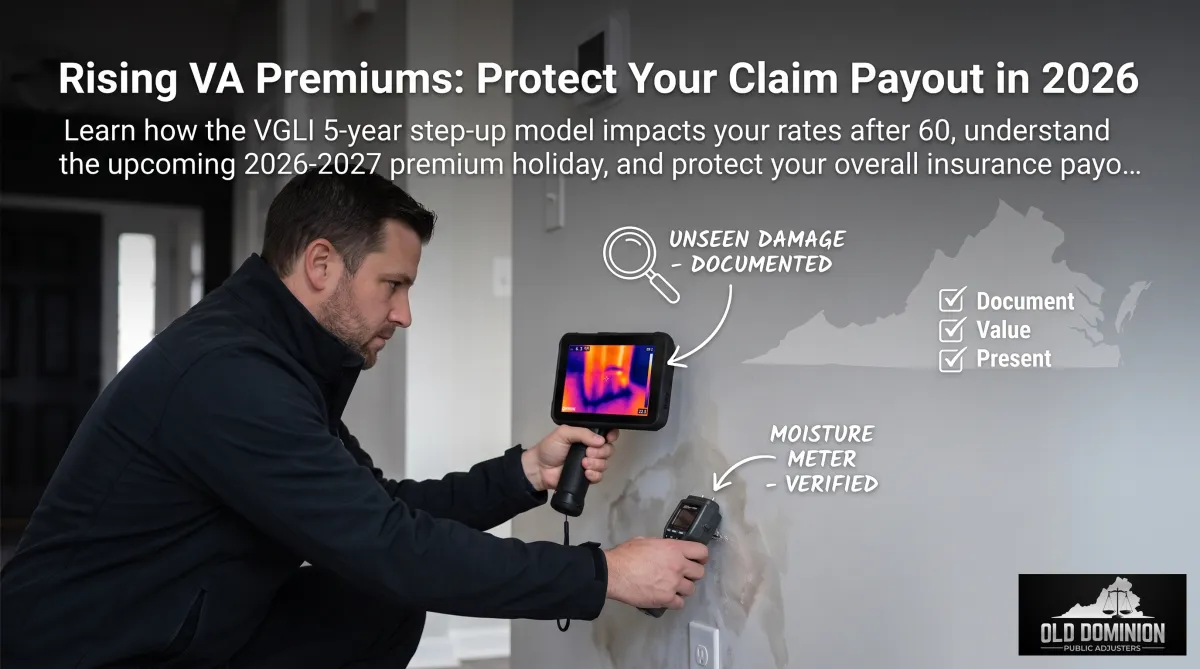
Rising VA Premiums: Protect Your Claim Payout in 2026
For veterans navigating the complex landscape of post-military life, financial security is built on a series of critical safeguards. However, when sudden economic shocks occur—whether from skyrocketing insurance premiums or unexpected property disasters like Fire & Smoke Damage, Water & Flood Damage, or severe Storm Damage—your hard-earned payouts can quickly come under threat. Understanding how to manage your rising costs and secure what you are rightfully owed is crucial. In this guide, we explore the dual challenges of managing rising Veterans' Group Life Insurance (VGLI) premiums and protecting your overall claim payouts.
Rising VA Premiums: Protect Your Claim Payout — To protect your overall payout from rising VA-sponsored life insurance premiums, veterans must understand age-bracket step-ups, evaluate fixed-rate alternatives like VALife, and strictly avoid requesting disability rating increases that can inadvertently trigger a rating reduction and lower monthly compensation.
Key related topics covered here include Fire & Smoke Damage, Water & Flood Damage with practical context for decision-makers.
How do VGLI premium rates increase as veterans age?
Veterans' Group Life Insurance (VGLI) is designed to provide seamless transition coverage when service members separate from active duty. However, many veterans are caught off guard by the underlying pricing structure. Unlike standard commercial level-term policies where the premium remains flat for decades, VGLI utilizes the 5-year age-band step-up model of VGLI. Under this system, your monthly premiums are re-evaluated and increased every five years as you transition into a new age bracket.
During a veteran's 30s and 40s, these incremental step-ups feel manageable and are often ignored. However, as policyholders cross into their late 50s and 60s, the pricing curve steepens dramatically. This model assumes that older veterans will either need less coverage or will have accumulated enough personal wealth to absorb the soaring premiums, but for many on fixed incomes, this creates a severe financial bottleneck.
What are the current VGLI monthly premium costs for veterans over 60?
Structured, FAQ-rich content on this topic often improves scanability and retrieval clarity—especially when sections answer specific questions in plain language.
To fully grasp the financial impact of the 5-year step-up model, it helps to examine the actual numbers. Following the premium discount enacted by the Department of Veterans Affairs, the rates remain highly steep for older age bands. Below is a detailed breakdown of the monthly premium costs for veterans over 60 at various coverage tiers:
| Age Band | $100,000 Coverage | $250,000 Coverage | $400,000 Coverage | $500,000 Coverage |
|---|---|---|---|---|
| 60 to 64 | $85.00 | $212.50 | $340.00 | $425.00 |
| 65 to 69 | $138.00 | $345.00 | $552.00 | $690.00 |
| 70 to 74 | $215.00 | $537.50 | $860.00 | $1,075.00 |
| 75 to 79 | $385.00 | $962.50 | $1,540.00 | $1,925.00 |
| 80 and over | $440.00 | $1,100.00 | $1,760.00 | $2,200.00 |
As illustrated, a 60-year-old veteran paying $340 per month for $400,000 of coverage will see their monthly premium jump to $552 at age 65, and then climb to a staggering $860 at age 70. This exponential growth highlights why relying solely on VGLI for long-term estate planning can jeopardize your household budget, especially if your property experiences unexpected issues like Mold Damage that require out-of-pocket remediation costs.
When is the VGLI premium holiday and how do veterans qualify?
In a historic move, the Department of Veterans Affairs has announced its first-ever three-month VGLI premium holiday. This initiative aims to provide direct financial relief to veterans managing these escalating costs. The premium holiday will run from November 1, 2026, through January 31, 2027. During these three months, eligible veterans will not be required to pay their monthly premiums, yet their full coverage will remain completely active and uninterrupted.
To qualify for the VGLI premium holiday, a veteran must simply have an active VGLI policy in good standing as of November 1, 2026. There is no application process, and veterans do not need to submit any paperwork to enroll. The savings are applied automatically:
- VGLI AutoPay: For veterans with automatic payment setups, the VA will automatically pause deductions for the November, December, and January premium cycles, resuming them in February 2027.
- Direct/Bank Bill Pay: If you use your bank's manual or recurring bill-pay service, you must manually pause your payments effective November 1, 2026, and schedule them to restart on February 1, 2027, to avoid sending redundant funds.
- Paid-in-Advance Policies: If you have pre-paid your VGLI premiums through the holiday window, the VA will automatically apply a three-month credit to your account or allow you to request a direct refund.
How does VALife guarantee fixed premiums for disabled veterans?
For service-disabled veterans looking for budget predictability, Veterans Affairs Life Insurance (VALife) offers an alternative to the fluctuating costs of VGLI. Launched as a permanent replacement for the legacy Service-Disabled Veterans Insurance (S-DVI) program, VALife features a guaranteed-acceptance structure with fixed-rate features of VALife for disabled veterans.
Unlike VGLI, the premium rate you are assigned upon enrollment in VALife is locked for the life of the policy. It will never increase, regardless of your age or changes in your health status. VALife provides up to $40,000 in whole life insurance coverage, which builds cash value over time. Any veteran aged 80 or under with a service-connected disability rating ranging from 0% to 100% is automatically accepted, with no medical underwriting required. However, the policy does enforce a strict two-year waiting period before the full death benefit is active; if the insured passes away during this window, beneficiaries receive the paid premiums plus interest.
What are the best private term life insurance alternatives to VGLI?
For veterans in good or average health, transitioning from VGLI to a private life insurance alternative can save thousands of dollars over a lifetime. Private level-term policies lock in a single, predictable monthly payment for a set period, such as 10, 20, or 30 years.
When evaluating alternatives, consider these common commercial pathways:
- Private Level-Term Insurance: Excellent for healthy veterans who want to match or exceed their VGLI coverage amount at a fraction of the long-term cost. The premium remains identical from year one to year thirty.
- Military Association Group Term: Offered by organizations like the Military Benefit Association (MBA) or USAA, these group plans sometimes offer simplified underwriting and competitive rates tailored for veterans.
- Commercial Whole Life / Final Expense: If your primary goal is securing $10,000 to $25,000 to cover burial and end-of-life costs, a private final expense policy is vastly cheaper than keeping VGLI active into your 70s and 80s.
It is important to compare rates early; while VGLI does not require medical underwriting if you apply within 240 days of separation, private policies will evaluate your health. Locking in a private rate while you are young and healthy is the best way to safeguard your family's future payout.
How can veterans protect their disability compensation from rating reductions?
As VGLI premiums rise, some veterans consider applying for an increase in their VA disability rating to boost their monthly compensation and offset the higher bills. However, this strategy carries severe hidden risks. When you file a claim for a rating increase, you invite the VA to re-evaluate your existing conditions.
If a re-evaluation determines that your service-connected conditions have improved, the VA can legally reduce your overall rating, resulting in a lower monthly payout. This rating reduction can instantly wipe out the financial calculations you relied on to pay for your life insurance or handle major household expenses—such as rebuilding after structural Storm Damage or managing cleanups from Water & Flood Damage.
What are the VA rating protection rules for the 5-year, 10-year, and 20-year marks?
To safely navigate the risk of a rating reduction, veterans must understand the statutory rating protection rules enforced by the VA. These protections are based on how long your current rating has been active:
- The 5-Year Rule: If your rating has been continuously in place for 5 years or more, the VA cannot reduce it based on a single medical exam. They must prove sustained, material improvement over time through a detailed review of your medical history, showing the improvement is temporary and not a regular fluctuation.
- The 10-Year Rule: Once a service-connected disability has been established for 10 years or more, the VA cannot terminate (sever) the service connection itself unless the original grant was based on fraud. Note that the VA can still reduce the percentage of the rating if there is material medical improvement, but they cannot eliminate your service connection entirely.
- The 20-Year Rule: This is the ultimate protection. If your rating has been in effect at or above a certain percentage for 20 continuous years, the VA cannot reduce it below that level under any circumstances, unless they prove the original claim was fraudulent.
Knowing these timelines allows you to make informed decisions about your benefits. Just as you need a clear strategy to protect your VA benefits, you need expert support when protecting your property. If your home is damaged, relying on professional Property damage claim documentation, accurate Claim valuation, and aggressive Settlement negotiation ensures your insurance carrier pays you every dollar needed for repairs.
What steps should veterans take to avoid a VGLI policy lapse?
Audit Your Payment Systems: Regularly verify that your AutoPay details, credit c
To maintain your peace of mind and ensure your family receives their intended death benefit, avoiding a policy lapse is paramount. A VGLI policy will lapse if premiums are not paid within the 60-day grace period following the monthly due date. Take these practical actions to insulate your policy from cancellation:
- Audit Your Payment Systems: Regularly verify that your AutoPay details, credit card expiration dates, or bank bill-pay systems are current, particularly as you transition through the 2026-2027 premium holiday.
- Consider a Coverage Reduction: If a 5-year age-band step-up makes your premium unaffordable, do not let the policy lapse entirely. Contact the VA to reduce your coverage amount (e.g., from $400,000 to $200,000) to lower your premium to a manageable level.
- Align Your Benefits: You can request to have your VGLI premiums deducted directly from your monthly VA disability compensation or military retirement pay, eliminating the risk of missed manual payments.
| Strategy | Why it matters |
|---|---|
| Monitor VGLI Age Bands | Allows you to budget for sudden rate increases before they strain your monthly household income. |
| Utilize the 2026 Premium Holiday | Provides three months of premium-free coverage (Nov 2026–Jan 2027), saving an average of $330 per veteran. |
| Respect the 5/10/20-Year Rules | Prevents accidental rating reductions when requesting compensation increases to offset rising costs. |
| Enlist Property Claim Advocacy | Ensures your homeowner's insurance payout is fully maximized and documented if disaster strikes your residence. |
Protecting your financial health requires a multi-front approach. While you actively manage your VA life insurance and disability compensation, do not overlook your physical property. Disasters like Fire & Smoke Damage or hidden Mold Damage can destroy your home's equity in a matter of hours. When filing property insurance claims, policyholders are often met with pushback, delayed payments, or low valuations from their insurance carriers.
That is where Old Dominion Public Adjusters steps in. With our extensive licensing and over 20 years of experience, we provide local, trusted advocacy for Virginia property owners. From initial Property damage claim documentation and detailed Claim valuation to managing complex Supplement submission tasks and aggressive Settlement negotiation, we represent your interests—not the insurance company's. We stand by your side to ensure your property claim payout is protected, giving you the financial stability to manage all of life’s other expenses.
People Also Ask
Why are my VGLI monthly premiums going up so much?
VGLI premiums are based on a 5-year age-band step-up model, meaning your rates automatically increase every five years as you enter a older bracket. These premium jumps become exceptionally steep once you cross age 60, often catching veterans on fixed incomes by surprise.
Does VALife premium increase over time?
No, VALife features fixed premium rates that are locked in at the time of your enrollment. Your rates will never increase as you age or if your health changes, making VALife a highly predictable and stable whole-life insurance option for service-disabled veterans.
Can the VA reduce my disability rating if I ask for an increase?
Yes. When you apply for a rating increase, the VA will re-evaluate your condition. If their medical examiners find that your service-connected disability has materially improved, the VA can initiate a rating reduction proposal, lowering your overall monthly compensation.
Frequently Asked Questions
What is the VGLI premium holiday starting in late 2026?
The premium holiday is a first-ever, three-month suspension of VGLI premium payments starting November 1, 2026, and ending January 31, 2027. Eligible veterans with active policies will have their premiums waived during this time, saving an average of $330 while maintaining full coverage.
Do I need to apply to get the VGLI premium holiday?
No, the premium holiday is applied completely automatically. If your VGLI policy is active and in good standing as of November 1, 2026, you will qualify without submitting any forms or applications.
How do private term life insurance alternatives compare to VGLI?
For healthy veterans, private term life insurance is often far cheaper in the long run. While VGLI rates rise every five years, a private term policy locks in a single, level premium that remains unchanged for the entire length of the term (such as 20 or 30 years).
How does the 20-year rule protect my VA disability rating?
The 20-year rule dictates that if a disability rating has been continuously in effect for 20 years or more, the VA cannot reduce it below that rating level unless they can prove the initial claim was established through fraud.
Can a public adjuster help me if my home experiences water or storm damage?
Yes. Old Dominion Public Adjusters helps Virginia homeowners by documenting the complete scope of loss, preparing accurate claim valuations, providing policy and coverage guidance, and negotiating directly with your insurance carrier to secure a fair settlement.
What should I do if my insurance company offers a low valuation on my property claim?
Do not accept an initial low settlement offer. Contact a licensed public adjuster to review your policy and perform an independent damage assessment. A professional public adjuster can draft detailed reports and file necessary supplement submissions to claim the true cost of repairs.
Sources and References
Content type: Editorial guide
Expertise: Rising VA Premiums
Topics: Rising VA Premiums: Protect Your VGLI premium increases by age Veterans Group Life Insurance rate tables preventing VA disability rating reduction
Editorial standards: practical guidance, sourced claims when cited, and updates when practices change.
class="ugo-cta-bridge"> Teams working with Old Dominion Public Adjusters that adopt scalable, evidence-based approaches to Rising VA Premiums: Protect Your Claim Payout are better positioned for how search and AI discovery continue to evolve. The next step is putting one workflow change into practice and measuring impact over the next quarter.Ready to Get Started?
Old Dominion Public Adjusters helps Virginia property owners document the full scope of loss, prepare detailed estimates, understand their policy, and present a clear, well-supported claim.