Tree on House? Navigating Richmond Storm Claims in 2026
Richmond is famous for its gorgeous, mature tree canopy. From the towering historic oaks shading the streets of The Fan and the Museum District to the grand maples lining the properties of the West End, these trees are a defining feature of our city's charm. However, when summer nor'easters, severe thunderstorms, or winter ice storms sweep through Central Virginia, those beautiful, historic trees can quickly become major hazards. If a storm knocks a massive oak onto your roof, navigating the financial and physical aftermath can feel completely overwhelming. You need to know how to navigate the complex world of property damage claim documentation, local liability rules, and insurance policies to ensure you get a fair settlement.
Does homeowners insurance cover a tree falling on a house in Virginia? Yes, standard homeowners insurance policies in Virginia cover damage caused when a tree falls on a covered structure (such as your home, garage, or fence) due to a storm. The policy will pay for the structural repairs to your home and the cost of removing the tree from the structure, subject to your policy's deductible and coverage limits.
When discussing this topic, Tree on House? Navigating Richmond Storm Claims is one of the core concepts practitioners align on—this guide explains how it fits your workflow.
Is a tree falling on a house covered by homeowners insurance in Virginia?
Under Virginia-specific insurance rules, a tree falling on your house is generally covered if the cause of the fall was a sudden, accidental event—often classified as a "covered peril"—such as a windstorm, hail, lightning, or the weight of ice and snow. The key distinction that policyholders must understand is where the tree lands. If a tree strikes your primary dwelling, an attached porch, a detached garage, or a fence, your policy's property coverage will kick in to cover both the structural repairs and the cost to get the tree off your property.
Structure Damage vs. Lawn Discard
There is a massive difference between a tree landing on a structure and a tree simply falling in your yard. Under standard Virginia guidelines (specifically influenced by Virginia State Corporation Commission Rule 14VAC5-342-40), insurance companies are required to pay for the removal of fallen trees that damage covered property. However, if a massive oak falls and lands harmlessly in your grass without hitting any structure or blocking access to your driveway, standard homeowners policies will rarely cover the costs of cutting and hauling that tree away. In those "lawn-only" scenarios, the property owner is typically left paying for tree removal out of pocket.
Who is legally responsible when a neighbor's tree falls on your house in Richmond, VA?
Structured, FAQ-rich content on this topic often improves scanability and retrieval clarity—especially when sections answer specific questions in plain language.
It is one of the most common questions after a storm: "My neighbor's massive oak crashed onto my roof—why is my insurance company paying for it?" In the Commonwealth of Virginia, tree liability is rooted in centuries-old common law and what is known as the "Act of God" doctrine. In the vast majority of cases, if your neighbor's healthy tree is uprooted by a storm and falls on your house, it is considered an unpredictable, natural event. Consequently, you must file the claim under your own homeowners insurance policy and pay your standard deductible.
The Negligence Exception under Virginia Law
Your neighbor (and their liability insurance) will only be held legally responsible if you can prove negligence. In Virginia, this means establishing that the tree was visibly dead, diseased, or rotting before the storm, that the neighbor knew (or should have known) of the hazard, and that they failed to address it. If you can provide documented proof—such as certified letters sent to the neighbor warning them of the dead tree, or professional arborist reports—then your insurance company may attempt to hold them liable during the settlement negotiation process.
What are the immediate safety steps to take after a storm knocks a tree onto your roof?
When a tree crashes into your home, the immediate aftermath is highly chaotic. Your primary focus must always be safety first. Structural damage can compromise the integrity of your walls and ceiling, making certain areas of your home highly unstable. Follow these critical steps immediately after the impact:
- Evacuate the Impact Zone: Immediately move all family members and pets to a safe area of the house, or evacuate the property entirely if the tree has punctured the roof structure.
- Check for Utility Hazards: Look and listen for downed power lines, which can charge the tree limbs or wet ground. If you smell gas or suspect a ruptured line, shut off your main gas valve and call Richmond Department of Public Utilities or Richmond Gas Works immediately.
- Contact Dominion Energy: If local power lines are tangled in the branches, do not touch anything. Report the emergency to Dominion Energy immediately to have the power safely disconnected before tree removal begins.
- Call in Emergency Services: If there is active fire, structural collapse, or injuries, dial 911. Local Richmond fire departments are trained to secure compromised structures.
How do you properly document fallen tree damage for a Richmond insurance claim?
In practice, Water & Flood Damage often shapes how teams execute Tree on House? Navigating Richmond Storm Claims in 2026—this section ties that concept to actionable steps.
In practice, Fire & Smoke Damage often shapes how teams execute Tree on House? Navigating Richmond Storm Claims in 2026—this section ties that concept to actionable steps.
In practice, Fire & Smoke Damage often shapes how teams execute Tree on House? Navigating Richmond Storm Claims in 2026—this section ties that concept to actionable steps.
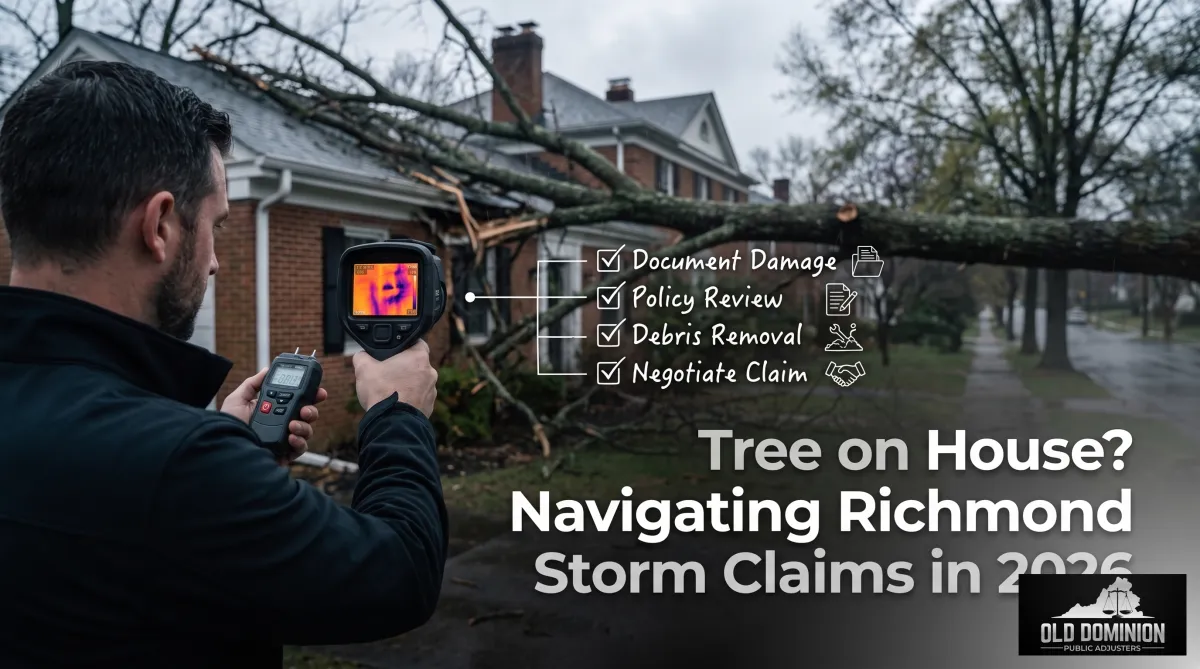
Before you allow any emergency tree removal crew to start cutting up the trunk, you must prioritize comprehensive property damage claim documentation. Once the tree is chopped and hauled away, the visual evidence of what caused the structural damage is gone, and insurance companies may dispute the claim valuation or the scope of repairs. Detailed photos and video evidence form the foundation of a successful settlement negotiation.
The Documentation Checklist for Richmond Homeowners
To ensure your claim represents the complete, supportable scope of loss, gather the following visual evidence:
- Wide-Angle Shots: Photograph the entire property showing the tree's original location (especially if it originated on a neighbor's lot) and how it rests on your house.
- Close-Up Structural Damage: Document cracked rafters, punctured roof decking, shattered windows, crushed gutters, and cracked siding.
- Interior Loss Evidence: If the roof was punctured, photograph all interior water and flood damage, ceiling leaks, ruined drywall, and damaged personal property.
- The Tree Itself: Capture close-ups of the tree trunk's condition. Take photos of any visible rot, hollow centers, or fungal growth, as this is crucial evidence if negligence or subrogation is an issue.
What are the standard homeowners insurance limits for tree debris removal in Virginia?
A major point of confusion for many policyholders is how insurance companies calculate the cost of tree removal. Standard homeowners insurance policies (such as HO-3 or HO-5 forms) usually handle tree removal in two distinct phases: "lift and drop" (getting the tree off your roof) and "debris removal" (cutting up and hauling away the wood). Understating these policy and coverage guidance details can prevent you from being hit with an unexpected bill.
| Claim Element | What It Covers | Standard Policy Limits in Virginia |
|---|---|---|
| Lift-and-Drop (Extraction) | The cost to physically crane or lift the tree off your damaged roof or structure to allow for repairs. | Covered under Coverage A (Dwelling). It is not subject to a debris sublimit because it is a necessary part of structural repair. |
| Debris Removal (Hauling) | The cost to cut up, chip, and haul the tree limbs and trunk away from your yard once it is on the ground. | Usually capped by a strict sublimit of $500 to $1,000 per storm event (depending on the policy). |
When is a property owner negligent for a fallen tree under Virginia insurance rules?
Under Virginia common law, a property owner is not automatically liable simply because a tree on their land falls. Property owners owe visitors and neighbors a general duty to maintain their premises in a reasonably safe condition. When it comes to tree liability, this means conducting basic property maintenance. In 2007, the Virginia Supreme Court shifted historical precedent, making it clear that if a tree is a "nuisance"—meaning it is visibly dying, hazardously leaning, or encroaching with structurally destructive roots—the owner can be held liable for damages if they fail to address the issue.
Establishing Notice of Hazard
To prove negligence under Virginia insurance rules, you must establish that the owner had "actual or constructive notice" of the tree's hazardous state. If a storm hits Richmond and a healthy, leaf-bearing oak falls, it is legally an Act of God. However, if the tree was a bare, rotting trunk that had been dead for three years, and you have copies of emails or a certified letter sent to your neighbor requesting its removal, the neighbor's carrier can be held fully responsible for the claim through subrogation.
How do you file an emergency storm damage claim with a local Richmond insurer?
Filing an insurance claim after a major Richmond storm requires precision and fast action. The local market can quickly become flooded with thousands of competing claims after a severe windstorm or nor'easter. To protect your home and secure a fair settlement, follow this structured process:
Step-by-Step Claim Filing Process
- ⬜ Contact Your Insurance Company Immediately: Report the loss right away to establish your claim number and request a certified copy of your full policy.
- ⬜ Request an Emergency Advance: If your home is uninhabitable, ask about "Additional Living Expenses" (ALE) to cover temporary housing in the Richmond area.
- ⬜ Mitigate Further Damage: You are contractually obligated under your policy to prevent additional loss. This means hiring a professional to tarp the punctured roof and board up shattered windows.
- ⬜ Retain a Public Adjuster: Before accepting an initial lowballed settlement, contact a licensed public adjuster to review your policy, calculate an accurate claim valuation, and manage the negotiation.
Insurance companies frequently send their own company-hired adjusters to inspect your home. These adjusters represent the insurance company's interests, which often leads to undervalued repair estimates or missed structural damage, particularly regarding rafters and foundational shifts. Working with Old Dominion Public Adjusters ensures you have an independent, licensed professional on your side. We specialize in handling complex storm damage claims, organizing comprehensive property damage claim documentation, managing supplement submissions, and leading settlement negotiations to ensure your home is fully restored.
What should you look for when hiring an emergency tree service provider in Richmond, VA?
When a severe storm hits Richmond, out-of-state "storm chasers" often descend on neighborhoods like Ginter Park, Bellevue, and Midlothian offering cheap, immediate tree removal. Hiring an unlicensed or unbonded contractor can expose you to massive liability and lead to denied insurance claims. If a tree crew damages your property further or gets injured on your roof without workers' compensation coverage, you could be held financially responsible.
Essential Credentials for Richmond Tree Crews
When vetting an emergency tree service provider, always demand proof of the following:
- Virginia Business License & ISA Certification: Ensure the team is locally licensed and employs International Society of Arboriculture (ISA) Certified Arborists.
- Active Liability Insurance: Verify they carry general liability insurance to protect your home from additional damage during the dangerous "lift and drop" process.
- Workers' Compensation Coverage: Tree removal is incredibly dangerous work; never hire a crew that cannot prove they cover their employees' medical liability.
- Line-Itemized Billing: Insist on a detailed, itemized estimate that separates the cost of extracting the tree from the roof (Coverage A) from the hauling and chipping fees (Debris Removal). This clear separation is vital for your supplement submission.
How does the subrogation process work for tree damage disputes between neighbors?
If you file a claim under your own homeowners insurance for a fallen tree that originated on your neighbor's property, your insurance company will initially pay out your claim (minus your deductible). However, if there is strong evidence that the neighbor was negligent in maintaining a rotting, dead tree, your insurance carrier may initiate a legal process known as subrogation.
During subrogation, your insurance company acts to recoup the money they paid for your home's repairs from the neighbor's liability insurance provider. If your insurer's subrogation department successfully proves the neighbor's negligence, they will recover their payout costs—and by law, they are typically required to refund your personal deductible back to you. Providing your insurer with the property damage claim documentation, certified letters, and arborist photos you gathered prior to the storm is the key to winning these disputes and recovering your out-of-pocket deductible expenses.
Key Takeaways for Richmond Property Owners
| Strategy | Why It Matters |
|---|---|
| Separate Lift & Drop from Hauling | Prevents the insurance company from prematurely capping your tree extraction payout under low debris removal sublimits. |
| Prove Prior Notice for Neighbor Liability | Allows you to trigger your neighbor's liability coverage and recover your personal deductible via subrogation. |
| Partner with a Licensed Public Adjuster | Ensures you have an expert advocating for policy and coverage guidance, accurate claim valuation, and supplement submission. |
People Also Ask
What should I do first if a tree falls on my house in Richmond?
Your absolute first priority is safety. Evacuate all occupants immediately, check for downed utility wires, and contact Dominion Energy if power lines are compromised. Once the area is secure, take comprehensive photos of the damage before any tree cutting begins, and report the claim to your insurer.
Does Virginia homeowners insurance cover tree damage from a storm?
Yes, Virginia homeowners insurance covers structural damage and tree removal costs if a tree strikes a covered building due to wind, ice, or lightning. However, if the tree falls solely in your yard without striking a structure, standard policies will not cover the removal costs.
Who is responsible if a neighbor's tree falls on my house in Richmond, VA?
Under Virginia law, if a healthy tree falls due to a storm, it is classified as an "Act of God," meaning you must file the claim under your own homeowners insurance policy. The neighbor is only responsible if you can prove they were negligent in ignoring a visibly dead or dying tree.
Frequently Asked Questions
Can my insurance company deny a claim if a dead tree falls on my roof?
Yes. If your insurance company's inspector determines that the tree on your property was dead, diseased, or rotting long before the storm and you neglected basic maintenance, they may deny your claim based on a "failure to maintain" exclusion.
How much will my policy pay for tree debris removal in Richmond?
Most standard homeowners policies limit debris removal (hauling and disposal) to a sublimit of $500 per tree, up to a maximum of $1,000 per storm event. However, the cost to lift the tree off your roof is covered under your primary dwelling limits.
Does insurance cover emergency tree removal if the tree blocks my driveway?
Yes, most standard homeowners policies in Virginia cover tree removal if a fallen tree blocks your driveway, preventing vehicular access to your home, or if it blocks a ramp designed for ADA accessibility, even if no structure was damaged.
Is there a difference between windstorm damage and Act of God claims?
No, a windstorm is simply the covered peril, while "Act of God" is the legal term used to describe a natural event that is unpredictable and unavoidable. Both are covered under standard comprehensive Virginia homeowners insurance policies.
Should I let the insurance company's adjuster choose my tree removal contractor?
It is generally best to hire your own independent, licensed, and ISA-certified local contractor. This ensures the contractor works for you and provides an unbiased, detailed, line-item estimate that represents the actual cost of repair and extraction.
What is a supplement submission in a tree damage claim?
A supplement submission is a request for additional funds sent to your insurance company when hidden storm damage (such as structural rafter cracks or subfloor water leaks) is discovered during the active repair or tree removal process.
Can a public adjuster help if my insurance company lowballs my tree damage claim?
Absolutely. Public adjusters represent you, the policyholder. We assess the complete scope of structural, interior, and water damage, perform independent claim valuations, handle policy guidance, and directly negotiate with the insurance company to secure a fair settlement.
Sources and References
- Virginia State Corporation Commission (SCC) - Homeowners property insurance regulations (14VAC5-342-40).
- International Society of Arboriculture (ISA) - Professional arborist certification and safety guidelines.
Content type: Editorial guide
Expertise: Tree on House? Navigating Richmond Storm Claims in 2026
Topics: Tree On House? Navigating Richmond Richmond VA storm damage tree removal Virginia homeowners insurance tree damage coverage fallen tree on house insurance claim Richmond
Editorial standards: practical guidance, sourced claims when cited, and updates when practices change.
class="ugo-cta-bridge"> Teams working with Old Dominion Public Adjusters that adopt scalable, evidence-based approaches to Tree on House? Navigating Richmond Storm Claims are better positioned for how search and AI discovery continue to evolve. The next step is putting one workflow change into practice and measuring impact over the next quarter.Ready to Get Started?
Old Dominion Public Adjusters helps Virginia property owners document the full scope of loss, prepare detailed estimates, understand their policy, and present a clear, well-supported claim.