Virginia's New Roof Insurance Law: What It Means (2027 Rule…
For years, homeowners across the Commonwealth of Virginia have faced a growing crisis: insurance companies canceling coverage, refusing renewals, or skyrocketing premiums simply because an asphalt shingle roof has passed an arbitrary age threshold. Even when a roof is completely functional, safe, and leak-free, many property owners have been forced to pay $10,000 to $20,000 for premature roof replacements just to keep their property insured.
To address this widespread issue, the Virginia General Assembly passed landmark legislation. Understanding how these statutory changes protect your property assets is critical, whether you are managing current storm damage or planning a future real estate transaction.
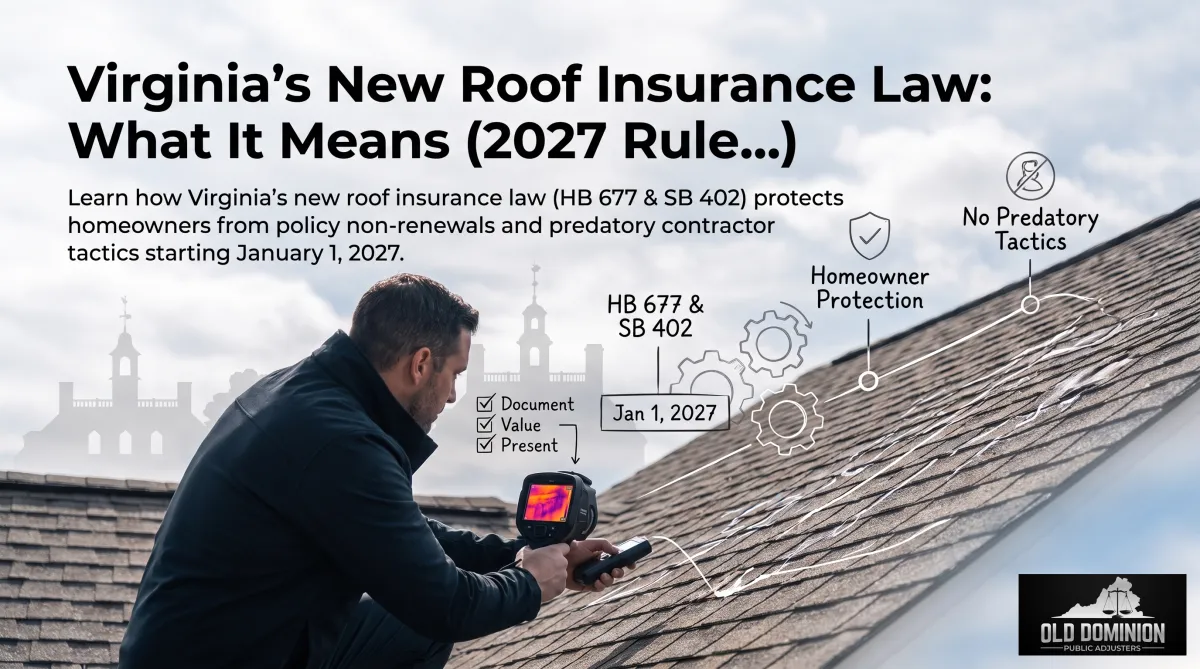
Virginia's New Roof Insurance Law: What It Means — Enacted through HB 677 and SB 402, this law prohibits insurance carriers from canceling, refusing to renew, or denying coverage on owner-occupied homes solely based on the age or condition of an asphalt shingle roof if the roof is 15 years old or newer, or if an inspector certifies an older roof has at least 5 years of useful life remaining.
Key related topics covered here include Fire & Smoke Damage, Water & Flood Damage with practical context for decision-makers.
Key related topics covered here include Fire & Smoke Damage, Water & Flood Damage, especially Virginia's New Roof Insurance Law: What It Means, with practical context for decision-makers.
| Strategy / Provision | Why It Matters for Virginia Homeowners |
|---|---|
| The 15-Year Safe Harbor | Insurers cannot drop owner-occupied policies or raise premiums solely based on roof age if the asphalt shingle roof is 15 years old or newer. |
| 5-Year Useful Life Certificate | Roofs older than 15 years can be certified by an authorized inspector to secure another 5 years of guaranteed insurance eligibility. |
| Deductible Rebate Ban | Contractors are strictly prohibited from offering to pay, waive, or rebate homeowners' insurance deductibles under the Consumer Protection Act. |
| Emergency Cancellation Rights | Homeowners gain a statutory 10-day window to cancel roofing contracts signed within 180 days of a declared state of emergency. |
What is the Virginia Roof Insurance Law taking effect on January 1, 2027?
Virginia's New Roof Insurance Law is a comprehensive consumer protection framework designed to stabilize the state's property insurance market and curb predatory contracting behaviors. Officially passed during the 2026 legislative session, the twin bills—House Bill 677 (patroned by Delegate Michelle Lopes Maldonado) and Senate Bill 402 (patroned by Senator Scott Surovell)—received overwhelming bipartisan support and were signed into law by Governor Abigail Spanberger. The legislation carries a delayed effective date of January 1, 2027, to allow the Virginia State Corporation Commission and insurance providers time to adjust their underwriting guidelines.
The law operates on two main fronts: regulating how insurance companies underwrite owner-occupied residential properties and establishing strict ethical guidelines for roofing contractors. Historically, insurers have used proprietary databases or satellite imagery to flag aging roofs, issuing abrupt non-renewal notices that leave policyholders scrambling. This law shifts the focus from arbitrary age thresholds to documented physical reality, ensuring that if a roof is functional, the policyholder cannot be unfairly penalized.
How do HB 677 and SB 402 stop insurance companies from dropping homeowners over roof age?
Structured, FAQ-rich content on Virginia's New Roof Insurance Law: What It Means often improves scanability and retrieval clarity—especially when sections answer specific questions in plain language.
Prior to this legislative reform, insurance carriers frequently issued flat denials or non-renewals for homes with asphalt shingle roofs approaching 15 to 20 years of age, regardless of the roof's actual condition. HB 677 and SB 402 modify Section 38.2-2114 of the Code of Virginia to stop this practice by creating a strict statutory "safe harbor". Under the new regulations, an insurer cannot refuse to write a policy, cancel an existing policy, decline to renew, or increase premiums solely due to the age of an asphalt shingle roof if that roof is 15 years old or newer.
If the roof is older than 15 years, the insurer is still prohibited from taking adverse action without first giving the homeowner or home purchaser the opportunity to provide written proof of the roof's actual age or to obtain a formal roof inspection. This prevents automated underwriting algorithms from dropping policyholders without a physical, human evaluation of the property's actual risk profile.
The Asphalt Shingle Roof Insurance Exceptions
While the law provides massive protections, it is not an absolute shield for neglected properties. Insurers can still deny or cancel coverage if the roof has active, unmitigated damage. These asphalt shingle roof insurance exceptions include:
- Active water leaks causing interior damage that the homeowner refuses to repair.
- Severe, unaddressed structural sagging or decking failure.
- Widespread moss, mold, or rot that compromises the physical integrity of the shingles.
- Unrepaired storm damage, such as missing shingles from wind or severe hail impact, which has not been filed or resolved.
What are the rules for certifying 5 years of useful life on a 15-year-old asphalt shingle roof?
For roofs that have passed the 15-year mark, the law introduces a practical certification pathway. If an insurance company threatens non-renewal based on the age of an older roof, the homeowner or prospective buyer has the right to pay for an inspection by an authorized inspector. If this inspector determines that the roof is structurally sound and has at least five years of useful life remaining, the insurer must accept the certification and maintain the coverage.
This rule effectively extends the insurable life of a well-maintained, high-quality asphalt roof. Instead of facing forced replacements at year 16, a homeowner can leverage professional inspections to keep their policy active, saving thousands of dollars while maintaining reliable property protection.
Who Qualifies as an Authorized Inspector?
To satisfy the statutory requirements under HB 677 and SB 402, the inspection must be performed by a qualified, independent third party. Authorized inspectors typically include:
- Virginia-licensed home inspectors in good standing with the Department of Professional and Occupational Regulation (DPOR).
- Licensed Virginia roofing contractors who carry valid credentials.
- Credentialed structural engineers or forensic building inspectors.
The inspection report must clearly state that a physical, visual inspection was performed, document the shingle condition, and explicitly state that the roof has a minimum of five years of useful life remaining.
Why is it illegal for Virginia roofing contractors to offer to pay or waive your insurance deductible?
A common marketing tactic among predatory "storm chaser" contractors has been offering to "waive," "absorb," or "rebate" a homeowner's insurance deductible. Contractors would often inflate their repair estimates to cover the cost of the deductible, essentially submitting false numbers to the insurance company so the homeowner pays nothing out of pocket. Starting January 1, 2027, HB 677 and SB 402 make this practice explicitly illegal under the Virginia Consumer Protection Act.
The ban is designed to prevent systemic insurance fraud, which drives up premiums for everyone in the state. If a contractor offers to pay or waive your deductible, they are violating Virginia law. Property owners are legally responsible for paying their designated policy deductible, and any agreement to bypass this requirement can invalidate the claim and expose both the contractor and the homeowner to severe legal liabilities.
When can a Virginia property owner legally cancel a contract with a roofing contractor?
High-pressure sales tactics often peak immediately following severe weather events, such as hurricanes in Hampton Roads or severe convective windstorms in Northern Virginia. To protect vulnerable homeowners from being trapped in unfavorable agreements, the new law introduces strict contract cancellation rights under a declared state of emergency. If the Governor declares a state of emergency applicable to your geographic area, and you sign a contract for roofing services within 180 days of that declaration, you are granted a statutory right to cancel.
Under SB 402 and HB 677, a property owner may legally cancel a roofing contract without penalty or obligation within the earlier of 10 days after executing the contract or by the official start date of the services. This gives homeowners a crucial safety net to review their options, consult with independent experts, and verify coverage with their insurer before work begins.
Mandatory Emergency Cancellation Contract Language
To ensure homeowners are fully aware of this right, Virginia law mandates that every residential roofing contract signed under these emergency conditions must contain the following disclosure in bold, capitalized, conspicuous lettering:
"YOU, THE RESIDENTIAL PROPERTY OWNER, MAY CANCEL THIS CONTRACT WITHOUT PENALTY OR OBLIGATION WITHIN THE EARLIER OF 10 DAYS AFTER THE EXECUTION OF THE CONTRACT OR BY THE OFFICIAL START DATE OF THE SERVICES BECAUSE THIS CONTRACT WAS ENTERED INTO WITHIN 180 DAYS OF THE DECLARATION OF A STATE OF EMERGENCY BY THE GOVERNOR. THE OFFICIAL START DATE OF THE SERVICES IS THE DATE ON WHICH THE WORK THAT INCLUDES THE INSTALLATION OF MATERIALS THAT WILL BE INCLUDED IN THE FINAL WORK ON THE ROOF COMMENCES, A PERMIT HAS BEEN ISSUED, OR A TEMPORARY REPAIR TO THE ROOF HAS BEEN MADE IN COMPLIANCE WITH THE VIRGINIA BUILDING CODE."
What strict advertising rules must Virginia roofing contractors follow under the new law?
To combat deceptive marketing, the 2027 law establishes rigorous guidelines for how roofing contractors can advertise their services. Roofers are prohibited from publishing, distributing, or broadcasting any advertisements that offer to pay, waive, or rebate a homeowner's insurance deductible. This applies to all forms of marketing, including digital emails, door hangers, flyers, yard signs, and pamphlets left on doorsteps.
Furthermore, contractors cannot advertise "free roofs" or use deceptive language that implies a property owner can obtain a complete roof replacement under an insurance claim with zero financial responsibility. Any advertisement must clearly convey that the homeowner is responsible for their deductible. These rules are heavily enforced, and any contractor found violating them will face enforcement actions, fines, and penalties under the Virginia Consumer Protection Act.
How does the new Virginia roof law impact home sales, buyers, and sellers?
The real estate markets in Northern Virginia, Richmond, and Hampton Roads have felt the strain of aggressive insurance underwriting for years. Prior to this reform, many home sales were delayed or completely derailed because a buyer's chosen insurance company refused to write a policy due to an older, but perfectly functional roof. Sellers were frequently forced to drop their asking price or spend over $15,000 to replace a roof that still had years of life remaining, simply to keep the transaction alive.
Under the new law, transactions can proceed with far less friction. If a home inspector confirms that the roof has at least 5 years of useful life remaining, buyers can present this certification to secure standard homeowners insurance. This stabilizes property values, reduces closing delays, and prevents unnecessary, costly roof replacements during negotiations.
Interacting with Manufacturer Warranties
It is important to understand how the new law interacts with existing manufacturer warranties. Many asphalt shingle roofs carry 25-year, 30-year, or limited lifetime warranties. However, these warranties only cover manufacturing defects, not natural wear and tear or storm damage. The 5-year useful life certificate focuses on the physical condition and structural integrity of the roof as it stands, regardless of whether the original manufacturer's warranty is still active. Having a copy of the original warranty can, however, serve as valuable written proof of the roof's actual age.
How should Virginia homeowners document their roof's condition to prepare for the 2027 changes?
With the new law taking effect on January 1, 2027, proactivity is your best strategy. To protect your property and ensure your insurance carrier respects the new statutory safe harbors, you must establish a comprehensive paper trail. If you cannot prove the age of your roof, or if you lack clear evidence of its condition, you lose leverage during policy renewals or storm damage claims.
Begin by compiling all physical and digital documentation related to your roof's history. Keeping these records organized secures your rights under HB 677 and SB 402 and ensures that if a storm, fire, or water event occurs, your claim is backed by undeniable proof.
Your 2027 Roof Documentation Checklist
- Proof of Age: Locate and organize your original roofing installation contract, building permits, and paid invoices.
- Warranty Records: Save all manufacturer warranty certificates and transfer documents to verify shingle quality.
- Visual Evidence: Take high-resolution photos of your roof from multiple angles annually to track wear and establish a clear timeline of condition.
- Maintenance Log: Keep receipts for any minor repairs, gutter cleanings, or moss treatments to prove proactive property maintenance.
- Professional Claim Support: Maintain contact with a licensed public adjuster to navigate complex property damage claims.
Navigating Claims with Old Dominion Public Adjusters
When your property suffers sudden damage from wind, hail, fire, or water, relying on the insurance carrier's assessment can lead to underpaid settlements. Old Dominion Public Adjusters provides professional representation exclusively for policyholders. We specialize in comprehensive property damage claim documentation, accurate claim valuation, and aggressive settlement negotiation to ensure your policy is fully honored.
From providing strategic policy and coverage guidance to managing complex supplement submission workflows, our team handles the heavy lifting so you can focus on restoring your home. Whether dealing with Fire & Smoke Damage, Water & Flood Damage, Storm Damage, or subsequent Mold Damage, we build a supportable scope of loss designed to maximize your recovery.
People Also Ask
Can my insurance company drop me because of my roof age in Virginia?
No, not if your asphalt shingle roof is 15 years old or newer. Under Virginia's new law (effective January 1, 2027), insurers cannot cancel or non-renew an owner-occupied policy solely based on roof age unless they allow you to get an inspection showing less than five years of useful life remaining.
What is the new roof law in Virginia for 2027?
Passed as HB 677 and SB 402, the law protects homeowners from arbitrary policy cancellations based on roof age. It guarantees coverage for functional asphalt shingle roofs under 15 years old and permits older roofs to stay insured if certified to have five years of remaining life.
Can a contractor waive my deductible under the new Virginia law?
No. Starting January 1, 2027, it is strictly illegal under the Virginia Consumer Protection Act for roofing contractors to pay, waive, or rebate any portion of a homeowner's insurance deductible, or to advertise such offers.
Frequently Asked Questions
When does the new Virginia roof insurance law take effect?
The law officially takes effect on January 1, 2027, applying to all owner-occupied residential property insurance policies written or renewed in the Commonwealth after this date.
Does the law apply to metal, slate, or tile roofs?
No. The specific safe harbor protections regarding roof age and non-renewals under HB 677 and SB 402 apply exclusively to owner-occupied dwellings with asphalt shingle roofs.
Who pays for the roof inspection to certify five years of useful life?
The inspection is performed at the expense of the property owner or the prospective home purchaser during a real estate transaction.
Can an insurer still raise my premiums because of an older roof?
Insurers are prohibited from raising premiums solely based on the age or condition of an asphalt shingle roof if it is 15 years or newer, or if it has a valid 5-year useful life certificate. Rate hikes based on broader regional risks are still permitted.
What happens if a roofing contractor violates the deductible rebate ban?
Violating the deductible rebate or waiver ban constitutes a prohibited practice under the Virginia Consumer Protection Act, exposing the contractor to lawsuits, heavy fines, and potential loss of licensure.
How long do I have to cancel a roofing contract after an emergency?
If signed within 180 days of a Governor-declared state of emergency in your area, you have until the earlier of 10 days after signing or the official start date of the services to cancel without penalty.
Sources & References
Content type: Editorial guide
Expertise: Virginia's New Roof Insurance Law: What It Means
Topics: Virginia's New Roof Insurance Law: What It Means Virginia's New Roof Insurance Law: can my insurance company drop me because of my roof age in Virginia what is the new roof law in Virginia for 2027
Editorial standards: practical guidance, sourced claims when cited, and updates when practices change.
class="ugo-cta-bridge"> Teams working with Old Dominion Public Adjusters that adopt scalable, evidence-based approaches to Virginia's New Roof Insurance Law: What It Means are better positioned for how search and AI discovery continue to evolve. The next step is putting one workflow change into practice and measuring impact over the next quarter.Ready to Get Started?
Old Dominion Public Adjusters helps Virginia property owners document the full scope of loss, prepare detailed estimates, understand their policy, and present a clear, well-supported claim.