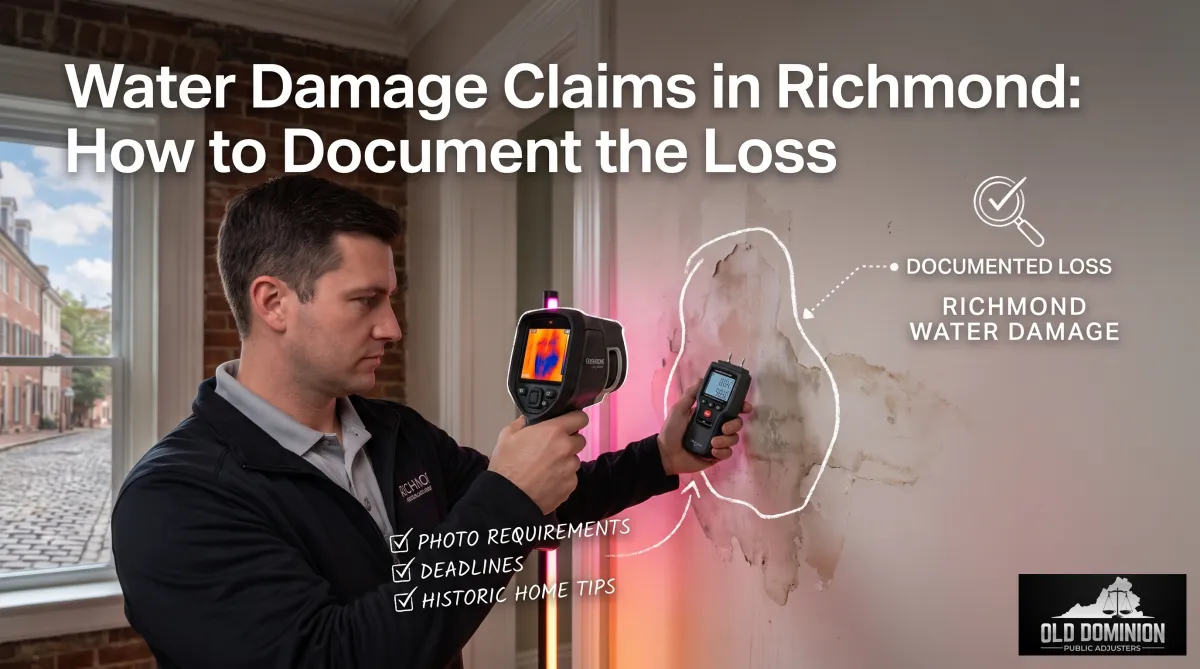
Water Damage Claims in Richmond: How to Document the Loss
Discovering water damage in your Richmond, Virginia property is a stressful, time-sensitive emergency. Whether you are dealing with a burst pipe in a historic Fan District basement, a sudden stormwater backup in Church Hill, or a ruptured appliance line in a modern West End home, the success of your recovery depends on one critical factor: property damage claim documentation. Understanding how to properly record and compile evidence of the damage is the single most important step you can take toward securing a fair and complete payout from your insurer or a liable third party.
Navigating the complex landscape of private homeowners policies, federal flood insurance, and municipal liability can feel overwhelming. This comprehensive guide outlines the exact, step-by-step methods Richmond property owners must use to document water damage in 2026. Armed with these strategies, you can establish clear proof of loss, navigate settlement negotiation with confidence, and avoid the typical pitfalls that lead to underpaid or denied claims.
The first step to document water damage for a Virginia insurance claim is to safely stop the water source and immediately establish a comprehensive, chronological visual record by capturing high-resolution photos and video walkthroughs of all affected areas, standing water, and ruined building materials before any water mitigation, cleanup, or structural demolition begins.
When discussing this topic, Water & Flood Damage is one of the core concepts practitioners align on—this guide explains how it fits your workflow.
Key related topics covered here include Water & Flood Damage, Storm Damage, especially Water Damage Claims in Richmond: How to Document the Loss, with practical context for decision-makers.
When discussing Water Damage Claims in Richmond: How to Document the Loss, Water Damage Claims in Richmond: How to Document the Loss is one of the core concepts practitioners align on—this guide explains how it fits your workflow.
How do I determine if my water damage claim belongs to private homeowners insurance or the City of Richmond?
In practice, Fire & Smoke Damage often shapes how teams execute Water Damage Claims in Richmond: How to Document the Loss—this section ties that concept to actionable steps.
In practice, Fire & Smoke Damage often shapes how teams execute Water Damage Claims in Richmond: How to Document the Loss—this section ties that concept to actionable steps.
Identifying the legal source of your water damage is essential for determining which administrative process to pursue. Richmond property owners frequently face water intrusion from two distinct origins: private plumbing system failures and public utility infrastructure failures. Successfully distinguishing between these two determines whether you must file a claim with your private insurance carrier or file a formal property damage claim against the City of Richmond.
Identifying the source of water intrusion (accidental vs. gradual leaks)
To establish where the claim belongs, you must pinpoint the exact physical point of failure. Private homeowners policies are designed to cover sudden, accidental, and internal water discharges—such as a ruptured hot water heater tank in your attic, a frozen pipe bursting behind drywall, or an overflowing bathtub. Conversely, gradual leaks that occur over months due to wear and tear, lack of maintenance, or structural deterioration are typically excluded by private carriers.
If the water source is external to your property boundary, the liability may lie with the municipality. For example, if a City of Richmond water main ruptures in the street and floods your basement, or if a clogged city-maintained storm sewer backup inundates your driveway, the damage is caused by public infrastructure. In these cases, you may have grounds to file a claim directly against the city, though you should also notify your private carrier to protect your contractual policyholder rights.
What initial actions must a Richmond property owner take to halt water intrusion before taking photos?
Structured, FAQ-rich content on Water Damage Claims in Richmond: How to Document the Loss often improves scanability and retrieval clarity—especially when sections answer specific questions in plain language.
As a Richmond property owner, you have a strict legal duty under Virginia insurance law to mitigate further damage to your property once a loss has occurred. This means you must take immediate, reasonable steps to stop active water flow and protect your home from progressive secondary damage, such as structural rot or hazardous mold growth.
Safely securing the property and halting active leaks
Before you pull out your phone to take photos, prioritize your personal safety. If the water has reached electrical outlets or is dripping through ceiling light fixtures, turn off the main electrical breaker to the affected zones immediately. Once safety is assured, locate and shut off the main water valve to the property, which is typically found in the basement, utility closet, or inside a water meter box near the street curb.
If you cannot shut off the water yourself, immediately call a licensed Richmond plumber to perform emergency repairs. Save any damaged pipe fittings, plumbing valves, or failed appliance parts. Do not throw these components away; they are vital physical evidence that your public adjuster or carrier's inspector will need to examine to verify the exact cause and origin of the water intrusion.
How to take insurance-compliant photos and video walkthroughs of water damage in a Virginia home
To successfully navigate settlement negotiation with your insurance carrier, your visual evidence must be clear, detailed, and undeniable. Standard insurance adjusters rely heavily on photographic evidence to build their scope of work, so your documentation must leave no room for interpretation or dispute.
Photographic capture strategy for maximum claim valuation
Start by capturing wide-angle, establishing shots of each damaged room to show the entire context of the water spread. Take photos of the water's high-water mark along baseboards and drywall using a tape measure to prove the depth of standing water. Next, capture medium-range photos of specific structural elements, and close-up, high-detail macro shots of the damaged items, cracked materials, and the failed plumbing component itself.
When recording video, execute a slow, continuous walkthrough of the affected spaces. Speak clearly to describe what you are filming, stating the date, time, and room name. Avoid rapid panning or shaking, which can obscure critical details. Be sure to document the contents inside cabinets, behind appliances, and underneath flooring if it has started to buckle or warp.
What specific details should be included in a personal property loss inventory list for an RVA claim?
When water damages your personal belongings, you must compile a comprehensive personal property loss inventory. This document, often called a content sheet, serves as the basis for your personal property claim valuation and directly affects the final payout for your contents.
Structuring your personal property inventory for maximum reimbursement
A vague entry like "damaged couch" will result in a heavily depreciated, minimal payout. Instead, you must provide granular detail for every item affected by the water intrusion. For every damaged piece of furniture, electronics, clothing, or household item, your inventory list must contain the following specific columns:
Essential Elements of a Property Loss Inventory| Inventory Field | Required Information to Document | Example Entry |
|---|---|---|
| Item Description | Exact brand, model, serial number, and material | Sony 65-Inch Bravia XR OLED 4K TV (Model XR-65A80K) |
| Date of Purchase | Approximate month and year the item was acquired | November 2022 |
| Condition Prior to Loss | Honest assessment of wear (Excellent, Good, Fair) | Excellent (no prior scratches or functional issues) |
| Replacement Cost Value | Current cost to buy the exact same or equivalent item today | $1,699.99 (sourced from local retailer listing) |
| Supporting Proof | Reference to receipt, photo filename, or owner manual | See Photo #IMG_4021.heic (shows waterlogged chassis) |
How to save and organize emergency water mitigation receipts to guarantee reimbursement from your insurer
Water mitigation is the process of drying out your property using professional dehumidifiers, air movers, and moisture-tracking equipment. Since this work must often start immediately to prevent secondary damage like mold, you will likely incur emergency expenses before an adjuster inspects the property. Securing full reimbursement requires flawless bookkeeping.
Documenting emergency mitigation and drying workflows
Keep a dedicated digital folder and physical binder for all transaction receipts, invoices, and contracts. Any emergency dry-out company you hire must provide a detailed dry-out log. This log should include daily moisture readings of your drywall, subfloors, and studs, showing that the equipment was necessary and actively drying the structure. If you buy your own wet-vacs, fans, or plastic sheeting to do the work yourself, keep those retail receipts; your policy and coverage guidance generally allows for the reimbursement of reasonable, out-of-pocket mitigation supplies.
What is the step-by-step process for filing a water damage claim with the Richmond City Attorney?
If your water damage was caused by a failure of municipal infrastructure—such as a city water main break or a municipal sewer backup—you must bypass the standard insurance routine and file a claim against the City of Richmond . Doing so requires strict adherence to Virginia statutory law and the city's internal procedures.
The 6-month statutory deadline and filing requirements
Under Virginia Code § 15.2-209, you must deliver a formal written notice of your claim to the City of Richmond within six (6) months from the exact date the water damage occurred . Failure to meet this strict 6-month statutory deadline legally bars you from recovering any compensation from the city, regardless of how clear their negligence might be .
To file the claim, you must draft a detailed, physical letter and deliver it to the Office of the City Attorney . Email or digital attachments do not satisfy Virginia state law . The physical letter must be addressed to:
Laura K. Drewry, City Attorney
900 East Broad Street, Suite 400
Richmond, VA 23219
Your property damage claim letter must contain the following information:
- The precise date and time of the incident .
- The exact location where the damage occurred (e.g., your address and the point of water entry) .
- A detailed narrative explaining what happened (e.g., "a city water main ruptured on Boulevard, sending water into my crawl space") .
- The name of any city departments or employees involved, if known .
- A clear description of the property damage .
- The estimated financial cost of your losses, backed by professional repair estimates, invoices, and photos .
- Your full name, current mailing address, and phone number .
Once received, the City Attorney forwards the file to the Risk Management Division . A claims administrator will investigate the claim to determine if the city is legally liable before approving any payout .
How do standard Virginia home insurance policies differ from federal flood insurance regarding loss documentation?
Many Richmond homeowners do not realize that standard private homeowners insurance policies do not cover damage caused by rising surface water, such as flash flooding from the James River or localized street flooding during a heavy storm. Knowing whether your claim is filed under a private policy or a federal policy changes how you must document your losses.
Filing claims through private homeowners insurance vs. NFIP flood policies
Private homeowners policies cover internal water issues (like burst pipes or sudden appliance overflows). To document these, you focus on the cause (accidental vs. gradual leaks) and the immediate physical impact. You generally have up to one or two years under Virginia law to fully document and adjust the claim, though prompt notification is always required.
National Flood Insurance Program (NFIP) policies, managed by FEMA, cover external flood events. The documentation requirements for an NFIP claim are incredibly rigid. You must file a formal, signed "Proof of Loss" statement within 60 days of the flood event. This document must contain precise, itemized repair estimates and manufacturer details. Furthermore, NFIP policies do not cover basement finishings, carpet, or personal property located in a basement or below the lowest elevated floor, making detailed height measurements and precise floor-level photos crucial during your documentation phase.
What documentation is required when restoring historic plaster or wood water damage in older Richmond neighborhoods?
Richmond is celebrated for its historic architecture, especially in older neighborhoods like The Fan, Church Hill, Jackson Ward, and the Museum District. However, when water damage strikes historic homes, standard insurance estimating software (like Xactimate) often vastly undervalues the cost of repair because it calculates rates based on modern, cheap materials like drywall and pine plywood.
Preserving and proving the value of plaster, heart pine, and historic masonry
If your historic home features lath-and-plaster walls, heart pine flooring, or historic hand-molded brick masonry, you cannot allow standard water mitigation crews to simply rip them out and replace them with drywall. You must document these historic materials with high-resolution photos that prove their age, craftsmanship, and historic integrity before any demolition occurs.
To secure a fair settlement negotiation, you must obtain specialized estimates from historical restoration contractors. These estimates must itemize the custom labor and material costs required to restore historic plaster or match historic heart pine, rather than using standard off-the-shelf modern replacements. Your public adjuster can utilize this specialized documentation to submit a supplement submission to the insurance carrier, ensuring your home's historic value is preserved.
What are the most common water damage documentation mistakes that cause claim denials in Virginia?
In Virginia's damp, humid climate, minor mistakes in how you document and manage water damage can quickly lead to a denied claim or an underpaid settlement. Avoiding these three critical documentation errors will keep your claim on track.
Crucial pitfalls to avoid during the claim process
- Failing to document and prevent secondary mold damage: In Virginia's humid weather, mold can begin growing within 24 to 48 hours of water exposure. If you fail to run dehumidifiers or delay documenting the initial water spread, the carrier may deny coverage for subsequent mold damage, claiming you failed to mitigate the loss.
- Throwing away damaged items before the adjuster inspects them: If you throw away a ruined leather sofa or a damaged water heater valve before the carrier's adjuster can visually verify its brand, model, and physical damage, they can deny that portion of your claim due to a lack of physical evidence.
- Relying on vague, undocumented repair estimates: Accepting a simple, one-page estimate from a general contractor that reads "repair water damage: $15,000" is a recipe for an underpaid claim. Insurers require highly detailed, line-item estimates that list exact measurements, materials, and labor hours.
| Strategy | Why it matters |
|---|---|
| Act Fast on Crawl Spaces | Richmond's historic crawl spaces trap moisture; prompt documentation prevents structural rot and mold denials. |
| Keep Failed Plumbing Parts | Preserves critical physical evidence needed to prove the cause of water intrusion (accidental vs. gradual). |
| Submit Detailed Supplements | Allows your public adjuster to correct lowball initial carrier estimates with real, historic restoration costs. |
People Also Ask
How do I document water damage for an insurance claim in Richmond?
To document water damage in Richmond, safely stop the water source, then take extensive wide-angle and close-up photos of all structural damage, standing water, and affected personal belongings. Save all emergency plumbing and mitigation invoices, and build a detailed personal property loss inventory list with model and serial numbers.
Can I claim water damage against the City of Richmond if a water main breaks?
Yes, if a city-maintained water main or storm sewer line causes damage to your property, you can file a claim against the City of Richmond. You must deliver a written claim letter to the Richmond City Attorney within six months of the incident to comply with Virginia's strict statutory filing deadline.
What pictures do I need to take of a burst pipe for home insurance?
For a burst pipe, take photos of the failed section of pipe, the surrounding pooled water, water stains on drywall or ceilings, buckled flooring, and all damaged personal items. Use a tape measure in your photos to document the high-water line on your walls to prove the depth of the water intrusion.
Frequently Asked Questions
What is the difference between a sudden water leak and a gradual leak?
A sudden leak, like a burst pipe, occurs instantly and is typically covered by standard Virginia homeowners insurance. A gradual leak, like a slow pipe drip inside a wall over several months, is considered a maintenance issue and is usually excluded from private policy coverage.
Does standard Richmond home insurance cover flood damage?
No, standard homeowners insurance policies in Virginia do not cover flood damage caused by rising surface water. To protect against flood damage from storm surges or river overflows, Richmond property owners must purchase a separate policy through the National Flood Insurance Program (NFIP) or a private flood insurer.
How long do I have to file a water damage claim against the City of Richmond?
Under Virginia Code § 15.2-209, you have exactly six (6) months from the date of the incident to file a written property damage claim with the Richmond City Attorney. This deadline is strictly enforced, and late filings are legally barred from recovering damages.
Why is mold damage documentation different in Virginia?
Virginia's highly humid climate accelerates mold growth following water intrusion. Property owners must document their drying and mitigation efforts immediately because insurance policies often have strict caps or exclusions on mold damage if mitigation is delayed.
Can I throw away wet carpets and drywalls before the insurance adjuster arrives?
No, you should never discard damaged structural materials or personal items before the insurance adjuster inspects them. If you must remove items for safety or health reasons, take detailed photos and videos of them first, and store them in an outdoor area (like a backyard or garage) for inspection.
What is a supplement submission in an insurance claim?
A supplement submission is a request for additional funds sent to your insurance carrier during the repair process. It is used when hidden water damage is discovered after the initial inspection, or when the actual cost of historic materials exceeds the carrier's original estimate.
Content type: Editorial guide
Expertise: Water Damage Claims in Richmond: How to Document the Loss
Topics: Water Damage Claims in Richmond: How to Document the Loss Water Damage Claims In Richmond: documenting water damage in Virginia Richmond property damage claim documentation
Editorial standards: practical guidance, sourced claims when cited, and updates when practices change.
class="ugo-cta-bridge"> Teams working with Old Dominion Public Adjusters that adopt scalable, evidence-based approaches to Water Damage Claims in Richmond: How to Document the Loss are better positioned for how search and AI discovery continue to evolve. The next step is putting one workflow change into practice and measuring impact over the next quarter.Ready to Get Started?
Old Dominion Public Adjusters helps Virginia property owners document the full scope of loss, prepare detailed estimates, understand their policy, and present a clear, well-supported claim.