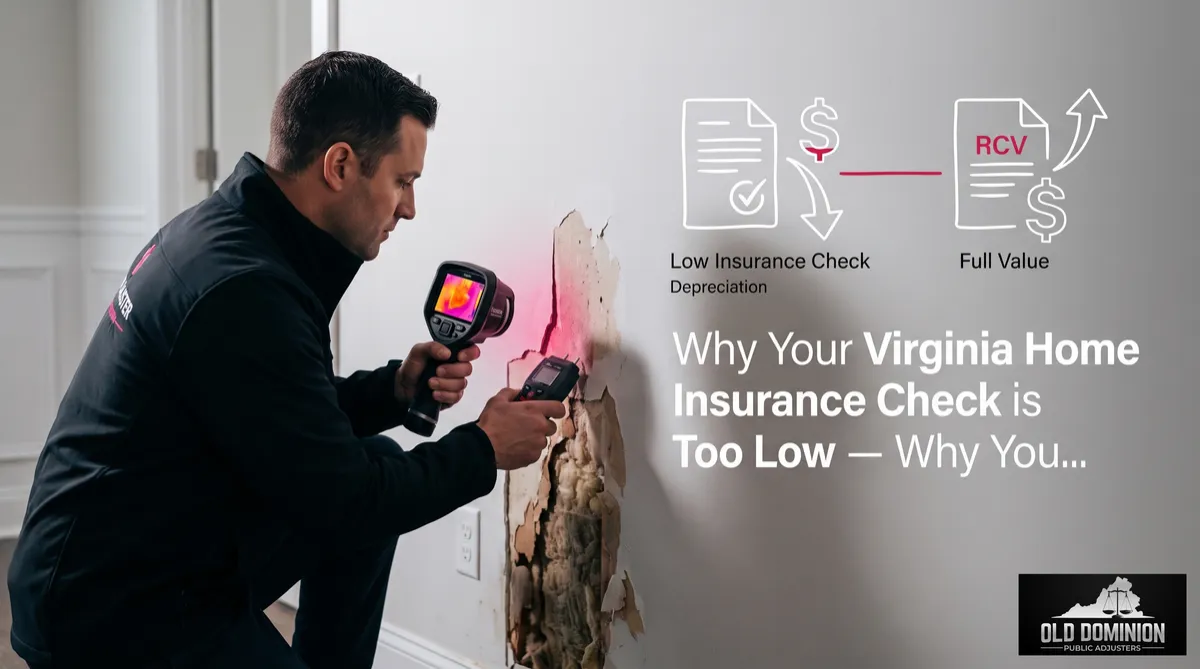
Why Your Virginia Home Insurance Check is Too Low — Why You…
When your Virginia home suffers property damage from a sudden storm, a burst pipe, or a devastating fire, you expect your homeowners insurance policy to step in and make you whole. However, many policyholders in the Commonwealth open their settlement envelopes only to find a check that covers a mere fraction of what their contractor estimated for the actual repairs. If you are wondering Why Your Virginia Home Insurance Check is Too Low, you are not alone.
Why Your Virginia Home Insurance Check is Too Low — Your settlement check is likely low due to Actual Cash Value (ACV) depreciation deductions , high percentage-based coastal deductibles , or automated estimating software (like Xactimate) that fails to reflect real-world Virginia labor rates. Under Virginia Code § 38.
Key related topics covered here include Claim valuation, Settlement negotiation, Policy and coverage guidance, Supplement submission, especially Why Your Virginia Home Insurance Check is Too Low, with practical context for decision-makers.
Navigating the complex insurance landscape in Virginia requires a solid understanding of both local regulations and the proprietary tools insurance carriers use to value property damage claims. This comprehensive guide will break down exactly why your payout fell short and provide actionable steps to dispute a lowball settlement offer.
1. Why Is My Virginia Homeowners Insurance Claim Payout Significantly Lower Than the Contractor's Repair Estimate?
It is incredibly common for a homeowner's independent contractor estimate to be twice—or even three times—as high as the initial check provided by the insurance company's adjuster. This discrepancy rarely stems from your contractor "padding" the bill; instead, it represents a fundamental mismatch in how damage is documented and priced.
The Disconnect in Claim Scope
A primary driver of low settlement checks is a rushed or incomplete insurance inspection. Staff adjusters often balance high caseloads, leading them to miss hidden structural issues. For example, in a water & flood damage claim, an adjuster might only allocate funds to paint a stained drywall surface, completely overlooking the trapped moisture underneath that requires professional structural drying and mold remediation. Meanwhile, your local contractor writes an estimate to complete the job safely and to local Virginia building codes, which naturally costs more.
Inclusion of Crucial Trades and Overhead
Insurance company estimates frequently omit "General Contractor Overhead and Profit" (O&P), which typically adds 20% to a reconstruction estimate. When a repair requires multiple specialized trades—such as a roofing crew, drywall installers, and electricians after severe storm damage or fire & smoke damage—a general contractor must coordinate the project. If your insurance payout excludes O&P, your check will immediately fall short of real-world project costs.
2. How Do I Determine If My Home Insurance Company Underestimated the Cost of My Property Damage in Virginia?
In practice, Water & Flood Damage often shapes how teams execute Why Your Virginia Home Insurance Check is Too Low — Why You…—this section ties that concept to actionable steps.
In practice, Fire & Smoke Damage often shapes how teams execute Why Your Virginia Home Insurance Check is Too Low — Why You…—this section ties that concept to actionable steps.
Structured, FAQ-rich content on Why Your Virginia Home Insurance Check is Too Low often improves scanability and retrieval clarity—especially when sections answer specific questions in plain language.
In practice, Water & Flood Damage often shapes how teams execute Why Your Virginia Home Insurance Check is Too Low—this section ties that concept to actionable steps.
In practice, Fire & Smoke Damage often shapes how teams execute Why Your Virginia Home Insurance Check is Too Low—this section ties that concept to actionable steps.
To identify where your insurance carrier cut corners, you must conduct a detailed, line-by-line comparison between the adjuster's estimate and your contractor's bid. Simply looking at the final dollar amounts will not tell you how to dispute the valuation.
Conducting a Line-by-Line Claim Audit
Review the line items in the insurance carrier's estimate sheet. Verify if they accounted for all damaged areas of your property. Common areas where insurance companies underestimate costs include:
- Material Quality: Check if the estimate specifies standard builder-grade materials when your home features custom plaster, historical woodwork, or architectural shingles.
- Omitted Work Activities: Look for missing operational steps, such as debris removal, scaffolding, content manipulation (moving furniture out of the work zone), and code-required upgrades.
- Inaccurate Measurements: Ensure that the square footage of your walls, ceiling, or roof matches the physical measurements of your home. Adjusters occasionally input incorrect dimensions into their software.
3. What Is the Difference Between Actual Cash Value (ACV) and Replacement Cost Value (RCV) Under Virginia Law?
The distinction between Actual Cash Value (ACV) and Replacement Cost Value (RCV) is one of the most critical concepts in property insurance, yet it remains a frequent source of confusion for policyholders.
Actual Cash Value (ACV) Explained
Actual Cash Value represents the fair market value of your property at the moment of the loss. It is calculated by taking the cost to buy a brand-new equivalent item (RCV) and subtracting physical depreciation based on age, wear, and tear. If your 15-year-old roof is damaged by wind, the ACV check will only cover the remaining useful life of that roof—often leaving you with a check for only 20% to 50% of what a new roof actually costs.
Replacement Cost Value (RCV) Explained
Replacement Cost Value is the actual amount of money required to repair or replace your damaged property with new materials of like kind and quality, without any deduction for depreciation. If you have an RCV policy, the insurance company is contractually obligated to pay for the full cost of repairs. However, they do not pay this full amount upfront.
4. How Does the Six-Month Virginia Statutory Time Limit (Code Section 38.2-2119) Impact My Replacement Cost Insurance Claim?
Under Virginia law, insurance carriers utilize a two-stage payment process for RCV policies. First, they issue an ACV check (which has depreciation deducted). Only after the repairs are completed and invoices are submitted will they release the held-back depreciation (recoverable depreciation) to match the full RCV of the repair.
The Critical Six-Month Clock under Virginia Code § 38.2-2119 B
In Virginia, policyholders must be incredibly mindful of the statutory deadline governing replacement cost claims. According to Virginia Code Section 38.2-2119 B, a policyholder has a statutory right to accept an ACV payment without forfeiting their right to claim the full replacement cost later. However, there is a strict catch:
"Any claim for such difference [between ACV and full replacement cost] must be made within six months of (i) the last date on which the insured received a payment for actual cash value or (ii) date of entry of a final order of a court of competent jurisdiction declaratory of the right of the insured to full replacement cost, whichever shall last occur."
If you fail to submit your final invoices and claim the held-back depreciation within 180 days of your last ACV check, your insurance carrier can legally refuse to pay the remainder of your claim, leaving you permanently stuck with the lowball ACV check.
5. How Do Regional Windstorm, Hurricane, or Hail Deductibles Affect Coastal Virginia Home Insurance Settlement Checks?
If you live in coastal regions like Virginia Beach, Norfolk, Portsmouth, or the Eastern Shore, your home insurance settlement check may be low due to specialized windstorm, hail, or hurricane deductibles.
The Shift from Flat Fees to Percentage Deductibles
While most homeowners are accustomed to a flat $500 or $1,000 deductible for standard claims (like a burst pipe or a small kitchen fire), coastal policies often feature percentage-based deductibles for storm damage. These deductibles are calculated as a percentage of your home's total dwelling coverage (Coverage A), not the amount of the damage.
For example, if your Virginia Beach home is insured for $400,000 and your policy features a 5% named storm deductible, your out-of-pocket share for a hurricane claim is a massive $20,000. If a storm causes $25,000 in roof and siding damage, your insurance settlement check will only be $5,000 after the deductible is subtracted. It is crucial to review your policy's declaration page to understand how these regional deductibles impact your payout.
6. Why Do Insurance Adjusters Use Software Like Xactimate That Fails to Reflect Local Virginia Contractor Costs?
Almost all major insurance companies utilize computerized estimating platforms, most notably Xactimate, to determine the cost of property repairs. While these tools aim to standardize pricing, their default regional settings frequently fail to reflect the true localized cost of construction in Virginia.
How Xactimate Underestimates Local Labor and Materials
Xactimate calculates pricing by averaging reported costs across broad geographic regions. This database methodology often falls short in several distinct ways:
- Historical Restoration Costs: In older, historic Virginia cities like Richmond, Alexandria, and Williamsburg, repairing plaster walls, slate roofs, or historic woodwork requires highly specialized craftsmen. Xactimate's default labor rates do not account for these premium wages, forcing adjustments far below actual subcontractor bids.
- Labor Shortages: Following a major regional storm event, the demand for local contractors skyrockets. Xactimate's database updates are notoriously slow to adapt to sudden spikes in local labor and material costs.
- Rigid Linear Foot Pricing: The software calculates painting and drywall repairs using rigid geometric formulas that ignore physical realities, such as protecting undamaged structural components, working in tight crawlspaces, or handling complex architectural layouts.
7. What Step-by-Step Actions Should I Take to Dispute a Lowball Home Insurance Settlement Offer in Virginia?
Disputing an underpaid claim requires a systematic approach. Property owners must build an evidentiary case showing exactly why the insurance carrier's scope and pricing are inadequate.
Your Step-by-Step Claim Dispute Checklist
- Review Your Entire Policy: Double-check your policy limits, deductible amounts, and whether you have an ACV or RCV policy.
- Secure an Independent Estimate: Obtain a detailed, itemized estimate from a licensed Virginia contractor. Ensure it is formatted with clear line-item labor and material costs.
- Document Everything: Take comprehensive photos and videos of all damaged areas, including close-ups of materials and structural damage.
- Submit a Claim Supplement: Have your contractor or public adjuster submit a formal supplement request to the insurer detailing the missing scope of work and price differences.
- Maintain a Written Communication Log: Keep a record of all emails, calls, and letters exchanged with your insurance company, noting dates, times, and names of representatives.
To help you understand the core differences between the steps of disputing a claim independently versus hiring professional representation, review the comparison below:
Approaches to Handling an Underpaid Claim in Virginia| Strategy | Pros | Cons | Best For |
|---|---|---|---|
| Self-Negotiation | No professional fee required. | Highly stressful; easy to miss complex policy terms or local building codes. | Minor, straightforward claims under $5,000. |
| Contractor Supplements | Contractors understand physical repair needs. | Contractors cannot legally negotiate policy terms or act as claim adjusters. | Standard repair scope adjustments on roofs or siding. |
| Hiring a Public Adjuster | Licensed claim experts handle documentation, valuation, and negotiations. | Contingency fee applies to the recovered claim amount. | Significant fire, water, storm, or mold damage claims. |
8. When Should I Hire a Virginia Public Adjuster or Contact the Virginia Bureau of Insurance to Resolve an Underpaid Claim?
If you have submitted a detailed contractor estimate and your insurance company continues to offer an insufficient payout, you have administrative and professional avenues to break the deadlock.
Filing a Complaint with the Virginia Bureau of Insurance
The Virginia Bureau of Insurance (a division of the State Corporation Commission) regulates all insurance activities in the Commonwealth. If you believe your carrier is acting in bad faith, stalling your claim, or violating policy terms, you can file an official complaint. While the Bureau cannot legally force an insurance company to pay a specific dollar amount, their inquiry obligates the carrier to respond in writing, which often uncovers overlooked details or prompts a re-evaluation of the claim.
The Role of a Licensed Virginia Public Adjuster
Unlike insurance adjusters sent by the carrier, a Public Adjuster is a licensed insurance professional who works exclusively for you—the policyholder. A public adjuster will perform a comprehensive physical damage inspection, write an independent, localized estimate, handle all negotiations, and ensure that your claim adheres strictly to Virginia's complex regulatory landscape, including the 6-month statutory limit in Virginia Code § 38.2-2119 B.
| Strategy | Why it matters |
|---|---|
| Track the 6-Month Deadline | Failing to file your replacement cost claim within 180 days of your last ACV payment can forfeit your right to full RCV funds under Virginia Code § 38.2-2119 B. |
| Challenge Xactimate Defaults | National pricing models fail to account for historic home repairs in places like Richmond or Alexandria and local subcontractor shortages. |
| Hire a Public Adjuster Early | Getting a licensed professional to document the full scope of storm, mold, fire, or water damage prevents initial claim underestimations from stalling your repairs. |
People Also Ask
Why is my Virginia home insurance claim settlement check so low?
Your check is likely low because the insurance company subtracted physical depreciation (Actual Cash Value), applied a high coastal percentage deductible, or used generalized software pricing that does not match actual labor rates in your specific Virginia city.
Does Virginia law allow me to claim full replacement cost after receiving an ACV check?
Yes, under Virginia Code § 38.2-2119 B, you have a statutory right to accept an Actual Cash Value check first and subsequently file a claim for the remaining replacement cost difference once repairs are completed.
Why is my insurance adjuster's estimate half of what my contractor quoted?
The insurance adjuster may have missed hidden damage during their inspection, omitted general contractor overhead and profit (O&P), or relied on broad regional pricing software that fails to reflect real labor costs in historic or storm-damaged areas of Virginia.
Frequently Asked Questions
How long do I have to file a property damage claim in Virginia?
Most homeowners insurance policies issued in Virginia contain a contractual suit limitation clause, which typically requires policyholders to file a lawsuit or formally finalize their disputed claim within two years from the date of the loss. Check your policy declarations page to verify your specific policy's time limits.
Can my insurance company refuse to pay for historic material replacements?
If you have a Replacement Cost Value policy, the insurance company is generally required to replace damaged structural components with materials of "like kind and quality." For historic homes, this means they must cover matching plaster, specialized trim, or historic roofing slate, rather than cheap drywall or vinyl alternatives.
What if the contractor finds hidden damage during the repair process?
This is extremely common in water and fire claims. When hidden damage is discovered after construction begins, your contractor must immediately stop work in that area, document the damage with photos, and submit a "claim supplement" to your insurance carrier for approval before repairing it.
Are public adjusters licensed in the Commonwealth of Virginia?
Yes, public adjusters in Virginia must be licensed, bonded, and regulated by the Virginia State Corporation Commission's Bureau of Insurance. They must complete rigorous background checks, pass a state licensing exam, and meet ongoing continuing education requirements.
How do percentage deductibles work for hurricanes in Virginia?
A percentage deductible is calculated based on your total dwelling insurance limit (Coverage A). If your home is insured for $300,000 and you have a 2% hurricane deductible, your deductible is $6,000. This amount is deducted directly from your insurance settlement check for any claim arising from a named storm.
Does filing a complaint with the Virginia Bureau of Insurance cost money?
No, filing a complaint with the Virginia Bureau of Insurance is a completely free administrative service provided by the state to protect consumers and ensure that insurance companies adhere to Virginia insurance laws and fair claim handling practices.
Content type: Editorial guide
Expertise: Why Your Virginia Home Insurance Check is Too Low
Topics: Why Your Virginia Home Insurance Check is Too Low Why Your Virginia Home Insurance Virginia homeowners insurance claim low dispute low insurance settlement offer Virginia
Editorial standards: practical guidance, sourced claims when cited, and updates when practices change.
class="ugo-cta-bridge"> Teams working with Old Dominion Public Adjusters that adopt scalable, evidence-based approaches to Why Your Virginia Home Insurance Check is Too Low are better positioned for how search and AI discovery continue to evolve. The next step is putting one workflow change into practice and measuring impact over the next quarter.Ready to Get Started?
Old Dominion Public Adjusters helps Virginia property owners document the full scope of loss, prepare detailed estimates, understand their policy, and present a clear, well-supported claim.